Process that produces results.
One EPD team, quarterly planning, shared specs, and cross-functional rituals that keep lean teams moving quickly and focused on outcomes.
One team, one dream.
No function is more valuable than another. Each brings its own skills and point of view, and the friction between them is how teams find the best answer.
Positive friction that ends in a better solution than any one function would reach alone. Friction that goes nowhere gets called out.
Debt runs both ways. With AI, anyone can ship anything. Designers who ship code respect the system, and engineers who ship UI respect the design.
No pedestals. No function’s priorities outrank the team’s goals, design’s included.
Left alone, product, engineering, and design drift into silos, each optimizing for what it’s paid to care about, until every function feels the others are in its way. Califa ranks the work the same way for everyone: the company’s mission first, the team’s goals second, the function’s priorities third.
- CompanyThe mission
- TeamThe outcomes they own
- FunctionTheir craft
“Califa seemed to have hired from my perspective the strongest design team in NYC for size/stage of the company.”
Planning with intention.
Califa runs planning for engineering, product, and design together, so every team knows what it’s building, why, and what it agreed not to build.
Quarterly planning that starts from the company’s annual goals. Every pod presents its priorities and trade-offs to the rest of EPD, and usability fixes are planned alongside new work.
One shared spec in place of the PRD, the design doc, and the technical design doc. Product writes the problem, design adds the experience, engineering adds the approach.
Shared headcount planning for the whole EPD org at once, with design planned alongside engineering at about one designer per six engineers.
Lean teams that ship.
AI made docs, decks, and mockups cheap, and plenty of teams now drown in them. Califa sets teams up to make fewer of them and put more in front of customers.
Two or three engineers, a PM, and a designer own a workflow from the first sketch to the shipped release. Every initiative has one named owner.
Teams write the problem down in a page and answer it with a working prototype. Califa judges them on what changed for customers, not on how many docs and decks they made.
With AI tools, designers build working prototypes in the time a mockup used to take. A designer’s top nav pass can be in the product and shipping within days.
Product and design run customer discovery together. Every project starts with real calls and support tickets, and the team hears feedback while the work is still cheap to change.
AI automates project management, research synthesis, and first drafts. People spend the hours it saves on judgment.
Califa cancels any meeting without a clear goal and outcome. Short written updates replace most status meetings, and people get their calendars back for deep work.
Cross-functional rituals.
Design is not just for designers. These rituals pull product managers and engineers into the work early, and are kept only for as long as they help.
Design jams
Most design teams only run crits. Jams are weekly working sessions where a designer brings an open problem and the room builds on it, with the project’s PM in the room for the product context.
Design crits
Open by default, with a rotating facilitator and presenter. The presenter says what kind of feedback they need, and early crits include a magic wand round: the version you’d build with no constraints.
Design studios
Before a new project starts, everyone it touches sketches together: two rounds of ten minutes, two minutes each to explain, one minute each on the best idea someone else had.
Goalfest
A weekly half hour where each designer rates last week’s goals and sets next week’s, plus a monthly retro on the process itself.
Broadcast every win.
Small wins are easy to miss, and celebrating them costs nothing. Califa shows the rest of the company what the team is working on, shipped and in progress.
EPD town halls
Every quarter at Heap, the town hall gave each improvement its own slide, however small. Teams started planning fixes to make the next deck, and the count went from 34 to 51 a quarter. Usability got its own ship weeks too, open to cross-functional peers and ending in town hall demos.
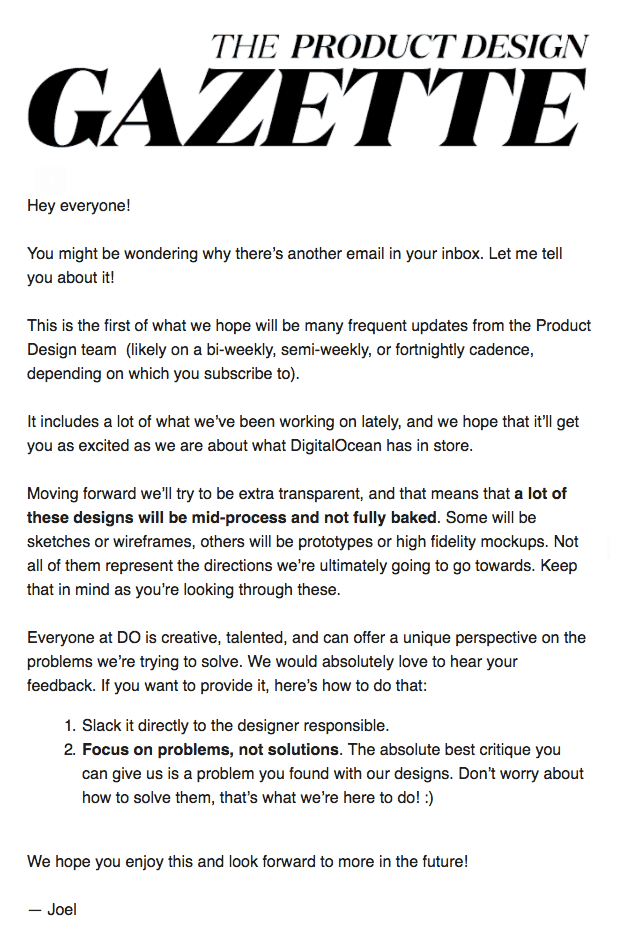
The Product Design Gazette
A biweekly email to the whole company with sketches, prototypes, and research in progress, flagged as unfinished. It kept everyone on the same page and built trust before big changes landed.
“Loving all this and please keep up the good & hard work of keeping DO simple.”

“still my favorite email to receive =]”

Leadership that clears the way.
Califa coaches each person, shares the context behind decisions, and removes what slows the team down.
Coach every designer with a growth plan built around their strengths and the gaps they want to close.
Share context by default so the team knows why work was prioritized and where the company is headed.
Clear roadblocks like procurement, legal, and data access before they slow a project down.
Build a team that makes good calls.
Califa builds one EPD team, plans with intention, keeps teams lean, and makes sure the whole company sees the work.