Product principles your team will use.
Align product, design, and engineering on a short set of principles that settle debates, guide scope, and keep a growing product easy to use.
Scale decision-making to combat complexity bombs.
Every platform starts with one product and one way to do things.
Then enterprise customers arrive, each with a short list of must-haves.
Every team ships the next thing on its roadmap, its own way.
Each new product has to work with every product that came before it.
And so forth. Each one adds a little complexity, until there's no room left.
Product principles help every team pick out what matters most and build around it.
They help us decide faster, together.
Without principles, debates about scope come down to personal taste, and every trade-off takes longer than it should. With them, the team can point to something everyone already agreed on: “this doesn’t raise signal from noise” settles the question faster than “this feels complicated.”
A long winding path with five decisions along it is pulled taut into eight quick, straight decisions.
They help us stay on course towards a vision.
A long-term vision is reached through hundreds of small decisions, and each one moves the product closer or further away. Principles keep every one of them pointed the right way.
A path of decisions drifts away from the product vision, then bends to end on it.
They help us raise the bar on quality.
Principles give teams one lens for reviewing each project and the product as a whole. The quality shows up in onboarding, adoption, and retention.
- Faster onboarding
- Higher adoption
- Higher retention
- Product-led growth
- Higher NPS
- Word-of-mouth growth
They can hold up for years.
Califa wrote seven principles for DigitalOcean in 2015 right as their product was starting to grow into a platform. Teams that never worked with Califa still ship against them, knowingly or not.
- 1
Is it object oriented?
- 2
Does it show the right thing?
- 3
Does it support scalable interactions?
- 4
Does it encourage user collaboration?
- 5
Does it let you keep your context?
- 6
Is it keyboard friendly?
- 7
Can it make developers better?
They help teams build with AI.
AI tools let PMs, engineers, and designers ship faster than ever. Principles give them the judgment to go with it: the criteria the team agreed on, written down where everyone can use them, including your new agent colleagues.
A prompt turns out six quick drafts. Once the team’s principles are attached, five are crossed out one by one and the last gets a check.
Califa Principles
A plug-and-play sure-fire way to ship quality at scale
Align on product vision and business goals
Align on a set of principles with a wide group
Formally roll out enablement for the principles
Best practices
Principles are explicitly not a requirement checklist.
Teams rank the principles by the value they bring to customers and the business, and by the effort they take. Every launch aims for them, but nothing has to check every box to ship. They are a decision-making framework for scope and trade-off conversations.
Principles are owned by anyone who builds, not just design.
Design runs the process, but the principles describe where the whole team thinks the product should go. Designers, PMs, engineers, and data scientists share them in kickoffs, critiques, team channels, and anywhere specs get shared. People outside the product team can use them too.
Principles need an articulated vision.
Big-picture business goals are reached through a thousand small choices in specs, reviews, and pull requests. Principles point each of those choices at the same goal, so a team writes down its vision before it writes its principles.
Principle effectiveness increases with repetition.
Principles work best when they come up in every kickoff, critique, and review. Each mention builds a shared language for debating trade-offs, and over time a shared muscle for making the call the principles would make.
See the process in action.
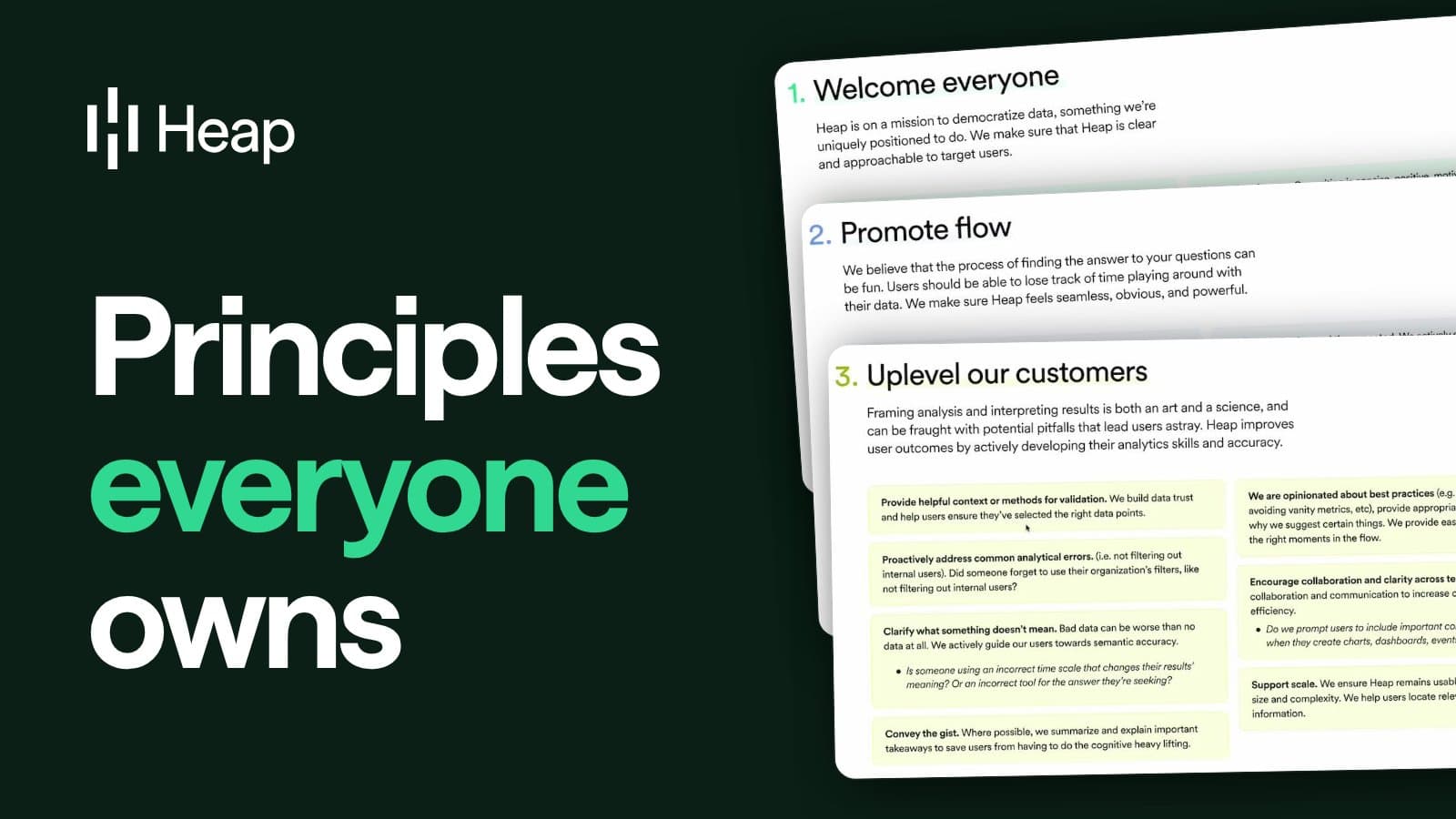
The kickoff recording from Heap’s principles week, from the vision the team worked back from to how the workshops ran.
 46 min
Define what good looks like.
Califa turns your product vision into a short set of principles your team can use in every review.