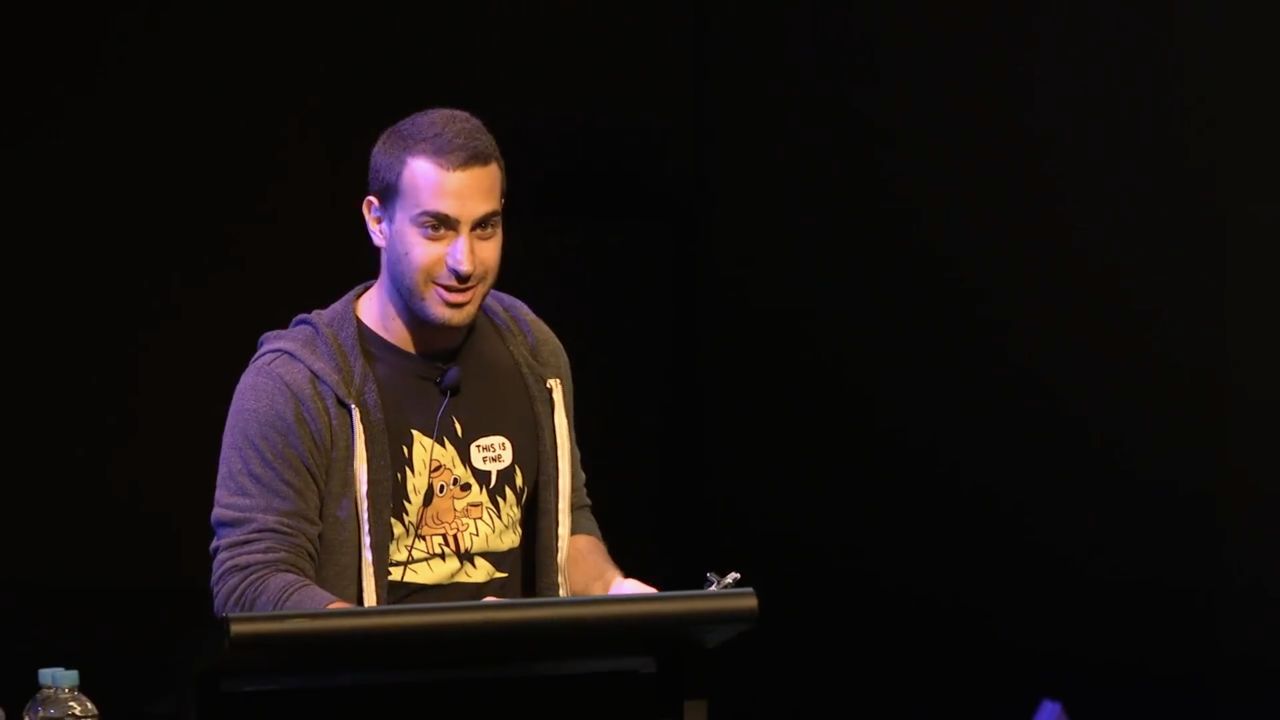
0:00 (upbeat music) 0:12 (audience applauds) 0:16 - Hey, everyone. 0:18 That was great, that was almost perfect. 0:19 (audience laughs) 0:21 Cool, so we're gonna start with, 0:24 I heard Andy took a selfie at the start of this, 0:27 and we're gonna one-up him. 0:29 So we're gonna do a video selfie of all of us. 0:33 So what I want everyone to do 0:34 is be happier than you've ever been in your life, 0:37 like smiles that seem like excruciating 0:40 to keep on your face, and then everyone go crazy. 0:43 Okay, so we're gonna do it. 0:46 That's not crazy, be crazy. 0:48 (audience applauds) 0:53 Cool, that was completely unrelated to the talk. 0:57 That was just for me. 0:59 We're having like a little competition, 1:01 and I just want it, I think. 1:02 (audience laughs) 1:04 Cool, so we're gonna talk about full-stack anxiety today. 1:11 What is that? 1:12 We'll find out. 1:13 So I'm gonna talk about a bunch of things. 1:15 First, who is this guy up front? 1:17 Who am I? 1:18 What brought me here? 1:19 Why am I speaking to you about this? 1:21 Why should you listen to me? 1:23 And who let me in? 1:25 Then we're gonna talk about full-stack anxiety. 1:27 What is it? 1:28 Why should you care, and, you know, spoiler alert, 1:31 it's not a great thing. 1:33 And finally, since it's not a great thing, 1:35 what can we do about it? 1:36 How can we alleviate it? 1:38 So, start with me. 1:42 (audience laughs) 1:44 You can tell I rehearsed, right? 1:46 Cool, so my name is Joel, and I am a unicorn. 1:49 And say hi, Joel. 1:51 - Hi, Joel. 1:53 - That's great. 1:54 Or a purple squirrel, which is a term. 1:58 Or a hybrid, you know, whatever you call one person 2:01 who does two things. 2:02 So basically, I'm a designer who codes. 2:06 I've been doing both for probably as long as I can remember. 2:09 And I don't really remember exactly how it started. 2:12 I think I was 12 or so, and I wanted to learn Photoshop 2:15 so I could make educational counter-strike posters. 2:19 With gems of wisdom like. 2:22 (audience laughs) 2:23 And, so 13-year-old me, obviously, 2:27 had a lot to say. 2:29 And this led me down to a path to forum signatures 2:33 and digital art sites. 2:35 And other things I thought were good at the time, 2:37 but in hindsight, clearly weren't. 2:40 And just like that, I was a designer. 2:43 At least, I thought so. 2:44 I was so genuinely proud of these creations 2:47 that I wanted to showcase them online. 2:50 Now, around the same time, this site was really big. 2:55 Has anyone heard of Neopets? 2:57 Yes, yes, a surprising amount of people 3:01 learned to design and code through this site. 3:04 The basic premise of the site 3:05 was caring for your virtual pets. 3:08 But really, it was secretly crack cocaine 3:10 for nerdy preteens. 3:11 And I remember checking this obsessively 3:14 during family vacations. 3:16 Anyway, Neopets let kids customize their pet pages 3:20 using HTML. 3:21 And people really loved custom stuff back then. 3:24 Remember, MySpace was basically the polar opposite 3:27 of what Facebook is today. 3:28 So people made pet pages like this, 3:31 or this, or this, or whatever this is. 3:37 (audience laughing) 3:38 And around the same time, Geocities was also really big. 3:41 (audience laughing) 3:47 It let anyone, as this demonstrates, have a website. 3:51 So yesterday's internet was really great 3:54 at creating developers. 3:55 There was less to consume, and so way more incentive 3:58 to create the content online. 4:00 And there weren't as many tools 4:01 with which to create the content. 4:03 Almost no tools at all. 4:04 So there was more incentive to learn 4:06 the basic building blocks of the web, like HTML. 4:09 So I did what any sane person would do 4:11 and spent the next couple of years 4:12 making really shitty websites, like this one. 4:15 Who's had this exact website? 4:19 Exactly like your corner and your blog and whatever. 4:22 Your page full of buttons. 4:24 And this one, and this grungy piece of shit. 4:27 (audience laughing) 4:29 And just like that, I was a web developer. 4:31 Again, at least I thought so. 4:33 So at this point, I think I am an amateur designer 4:36 and developer. 4:37 Amateur being a nice word for really, 4:39 almost insultingly bad at both. 4:42 So for the next decade, I spent a lot of time 4:44 growing in both directions. 4:46 On the design side, I like how big 4:49 that hot air balloon is over here. 4:51 So on the design side, I learned the classics 4:53 like CorelDRAW and Photoshop, Fireworks, Illustrator, 4:57 and then After Effects for Motion Graphics. 4:59 On the visual side, I got better 5:01 by learning color theory, typography, grid systems, 5:05 and then getting better by copying what I saw. 5:07 So Grunge and Web 2.0 and any other trends. 5:11 And on the dev side, at the same time, 5:13 I grew from front page, any front page fans here, 5:18 to like more senior text editors like Dreamweaver. 5:21 (audience laughs) 5:23 I grew from table-based HTML to Flash, 5:27 who's had a kind of shameful Flash period in their life. 5:32 Not shameful. 5:33 Shameful. 5:34 (audience laughs) 5:35 Cool. 5:36 So I built websites with tables and Flash, 5:38 CSS, JavaScript, and then I learned TextMate, 5:41 some backend languages, and so forth. 5:42 So I'm getting a little bit better each day, 5:45 and at some point, I'm, I mean, all this time, 5:47 I'm also freelancing and creating shitty album covers 5:50 and posters and websites, and at some point, 5:52 I joined a web agency as a visual designer. 5:55 So I still sucked, and at some point, 5:57 I reached the level of conscious incompetence, right? 6:03 That Ira Glass quote of like, I had the taste, 6:05 but I really couldn't pull it off. 6:07 So I figured I should probably actually learn 6:09 some of this stuff and maybe pick up a real one of these 6:12 while I'm at it. 6:14 But even though I was working as a designer at this point, 6:18 I wasn't really sure what to call myself. 6:21 So was I a designer, or was I a developer? 6:25 I was equally interested in both, 6:27 and I never really spent much time thinking about titles. 6:32 But if I wanted this fancy diploma, I needed to choose, 6:35 right, would it say communication design, 6:37 or would it say computer science? 6:39 What would I even go to school for? 6:42 But choosing was really hard, so I skipped it. 6:46 Yeah, I found a program called 6:48 Design and Technology in New York, 6:50 which would teach me, you guessed it, 6:52 both design and technology, and four years later, 6:55 I was a hybrid, certified. 7:00 So these days, I lead product design at DigitalOcean. 7:04 For those of you who don't know, 7:06 I mean, Una works there too, but it's an awesome company 7:08 that provides simple cloud infrastructure for developers. 7:12 Super interesting, right? 7:13 No, it is, I really enjoy it. 7:15 So at DO, I've done everything from strategy, to UX, 7:18 to visual design, to front end. 7:19 So it was very in line with the path I set on 7:22 over a decade ago. 7:24 So, that's me in an eggshell. 7:27 (audience laughing) 7:34 So these days, people usually know me 7:35 as this sad upside down face guy. 7:37 Hopefully, in real life, I'm less sad, 7:40 less upside down, and less a cartoon. 7:42 So hello, but this talk isn't just about me, 7:45 so everyone can let out their sighs of relief. 7:48 It's about how to deal with being one of these. 7:51 A unicorn, a designer who codes, 7:54 or a full stack developer, which more and more of us 7:56 find ourselves becoming these days. 7:59 So I'm gonna focus on designers who code, 8:02 'cause that's what I am, and that's what I can speak to, 8:04 but I hope this can be as relevant to any kind of hybrid. 8:07 So if you're a full stack developer, 8:10 if you're a developer who designs, 8:11 if you're an illustrator who runs a business, 8:13 or maybe a designer who started managing, 8:16 I hope this can hit home for you, 8:18 or maybe anyone at all currently working in our industry. 8:22 So before I start whining, and consider yourself more 8:26 and I'm about to start whining for a while, 8:28 I wanna say that we're extremely lucky. 8:30 We're basically working in the best profession 8:33 on Earth right now. 8:35 There are a ton of jobs in the intersection 8:37 of design and tech, right? 8:39 It's a seller's market. 8:40 It's preposterously in the favor of those of us 8:42 with the right skills. 8:45 But at the same time, and that comma right there 8:48 is where I start whining, 8:49 there are way, way higher expectations. 8:52 So those of us who've been in the game for a while 8:54 can remember that designers who code used to be rare. 8:57 It used to be special. 8:58 But these days, it's almost a requirement. 9:01 There are more startups than ever before, 9:03 and startups expect their employees to wear many hats. 9:06 And what this means is becoming a hybrid 9:09 is more important than ever. 9:11 On top of that, the tech landscape is changing so rapidly 9:15 and there's a ton of pressure to be up to date 9:17 on a hundred different things at any given time. 9:20 So I remember when the concept of T-shaped designers 9:24 first became popular. 9:25 Has anyone heard of this? 9:27 A bunch of people. 9:28 So this was popularized by Apple, I think. 9:30 The horizontal bar represents 9:32 a relatively shallow foundation in a lot of fields. 9:35 Say, I know enough about information architecture, 9:38 interface design, copywriting, lettering, and code. 9:42 Right, and the vertical bar represents deep expertise 9:46 in one field, say, in user experience specifically 9:49 while maintaining that shallow foundation 9:51 in all the other fields. 9:52 And the quote, "I'm only hiring T-shaped designers," 9:56 represents really disconcerting employer expectations 9:59 because what they're saying is, "I want a specialist, 10:02 "but one who can also do everything else." 10:06 Right, so this doesn't sound easy, right, 10:09 but it sounds doable. 10:10 It sounds like we'll do nights and weekends, 10:12 we'll spend some time, we'll get there. 10:14 But let's consider that first, 10:16 becoming an expert takes years. 10:19 So Malcolm Gladwell famously said 10,000 hours, 10:22 and that's even without juggling 10:23 all these other skills simultaneously. 10:25 And two, coupled with that, we have limited time. 10:29 So if you spend, oh, can you hear me fine? 10:33 Dope, cool. 10:34 So if you spend optimistically half of your time coding, 10:37 illustrating, and writing, will you have the time 10:40 to be the best UX designer you can possibly be? 10:43 Will you have the time to read up on new design patterns 10:45 to build personas or polish user flows, 10:48 or ask the right questions during your user tests? 10:51 Will you do your best work? 10:53 And even if you somehow do, will you manage 10:56 to stay amazing at that while also maintaining 10:59 all of your other skills? 11:00 Because remember, you weren't just hired 11:02 for one of your skills. 11:03 You were hired for all of them. 11:05 And focusing on one means you aren't applying the rest. 11:09 So being a unicorn is great, 11:11 but having a horn on your head 11:12 can get a little bit uncomfortable. 11:16 Pause for laughter. 11:17 (audience laughing) 11:19 And it's even worse. 11:20 Actually, T-shaped designers 11:22 are apparently not enough anymore. 11:24 I'm never hiring T-shaped designers again. 11:26 No one's ever said that, but you get it. 11:28 So the new hip thing I shit you not 11:31 is a W-shaped designer. 11:35 This is real. 11:36 This is like recruiters have talked to me about this. 11:38 So now hiring managers are looking for designers 11:40 who are experts in not just one, but two fields. 11:42 That's what those bumps are. 11:44 Say both visual design and experience design 11:46 while maintaining that foundation and all the rest. 11:48 So coding, lettering, et cetera. 11:50 And what they're basically saying is 11:51 I want a person who can do absolutely everything. 11:55 (audience laughing) 12:00 So lame old T-shaped designers just can't compete. 12:03 And this is kind of scary, right? 12:04 How can we possibly live up to these expectations? 12:08 And these are really big expectations. 12:11 So let me take a drink of water. 12:12 Sorry, it's all the way over here. 12:16 Super awkward. 12:21 We're gonna be talking about all the things now. 12:23 So let's say I am a front-end developer. 12:28 I'm expected to learn SVG animations. 12:31 And Node, or React, or Ember, or Meteor, 12:34 some kind of JavaScript framework, 12:36 even though these are slightly different. 12:38 BEM principles get better at CSS, write more elegant code, 12:42 get better at using the Web Inspector 12:44 and all the new features, get better at Sublime Text, 12:47 maybe finally learn VIM. 12:48 But I'm also a visual designer, 12:50 so I'm expected to stay up to date 12:52 on trends like Material or Flat or skeuomorphic. 12:55 Maybe not somewhat skeuomorphic anymore, but once I did. 12:57 And Photoshop and Fireworks, some time I did, 13:00 but not anymore, I guess. 13:01 And Sketch, better typography, lettering, and illustration. 13:04 And I'm a UX designer, so remote user testing, 13:06 best practices for building personas. 13:07 Information architecture, Android or ICE design, 13:09 some kind of mobile thing. 13:11 Pixate or Framer, I need to learn 13:13 how to actually make the things I'm doing. 13:15 I make them move. 13:16 I don't wanna be obsolete, so maybe 3D environments. 13:19 I don't wanna be a 2D designer 13:20 where all the kids are 3D designers, right? 13:22 And maybe Internet of Things, and I'm a manager, 13:23 so leadership training is good one-on-ones. 13:25 Giving feedback, accountability, discussions, building paths, 13:28 job sculpting, and I'm a teacher, 13:29 so curriculum building, best practices 13:30 for getting people to learn. 13:32 And I'm a consultant, so negotiations and contracts 13:34 and setting up a business, and I'm a human being, right? 13:38 So I can't possibly learn all of these things. 13:42 So what do I choose? 13:44 Do I become a better front-end developer, 13:48 or better UX designer, maybe a better manager? 13:51 What's more important to me? 13:52 What's gonna be better for me in the future? 13:54 And if I choose to focus on visual design, 13:57 do I get better at illustration? 13:59 Or do I learn sketch and get better at UI design? 14:03 Right, the choice isn't easy 14:04 because I'm not just choosing what to learn here. 14:07 I'm also choosing what not to learn, where not to grow. 14:11 So most of the people we call unicorns 14:13 are either designers who kind of code, 14:16 or developers who kind of design. 14:18 In most cases, every choice to grow in one discipline 14:21 is also a choice not to grow in another. 14:24 And these are important, life-influencing decisions. 14:27 There's not always a clear winner, right? 14:30 All of these skills are relevant 14:33 in some way to my day-to-day. 14:34 They'd all be useful, but I still need to make a decision. 14:38 What will I be able to bring to the table in a year? 14:41 What's gonna be my stack? 14:44 So to illustrate this, let's use a spider graph, 14:47 'cause everyone loves spider graphs. 14:49 I love them, you love them. 14:51 On this we agree, and our friends. 14:54 (audience laughing) 14:55 So this is you. 14:57 This represents your stack in this hypothetical scenario. 15:01 So here you are, try to put yourself in these shoes, okay? 15:06 Cool. 15:07 So here you're a UX heavyweight. 15:09 You're really solid at front-end development, 15:11 and on top of that you can design interfaces relatively well. 15:15 So you're what people usually call a unicorn. 15:18 And you also have some teaching skills, 15:20 but it's kind of irrelevant. 15:21 What you were really hired for was user experience, 15:24 visual design, and front-end, these three. 15:29 So let's say in this hypothetical scenario 15:32 that you just transitioned into managing your team, right? 15:36 You think to yourself, oh shit, 15:38 I'm leading a team of designers right now, 15:39 and I have no idea what I'm doing, 15:42 as many new managers do. 15:44 So your priorities have shifted. 15:46 So okay, no more fiddling around with JS or Sketch, got it. 15:50 So let's do that, let's grow as a manager, 15:52 let's do the training, let's read the books. 15:55 But as you spend time on this, 15:57 you're not putting time into the rest of these skills. 16:01 You're not learning new UI stuff, UX or code stuff, 16:04 and worse, you're not practicing as much. 16:08 So they shrink a bit. 16:10 It's inevitable. 16:12 And what used to be this, aka you, is now this. 16:18 But more importantly, these, the skills 16:21 that got you the job in the first place, 16:22 the skills you were hired for, now look like this. 16:27 And what that means is that getting a job in the future 16:30 with those same skills is gonna be much harder. 16:35 On the other hand, this, management, now looks like this, 16:39 which means you have a better chance 16:41 at getting design leadership positions, 16:43 if that's what you want. 16:46 If you made other decisions, 16:47 your skillset could also become this. 16:49 Now you're a specialist, you're an industry expert in UX, 16:53 if you spend all your time on it. 16:55 Or this, if you found yourself focusing more 16:57 on development instead of design. 17:00 So what I'm saying is that every decision 17:02 you make matters a lot. 17:05 The stakes are real. 17:06 What's gonna make you successful? 17:08 What's gonna make you happy? 17:11 So a simple question like this, what do I learn, 17:15 can become really scary. 17:17 So let's take a look at some of that list again. 17:20 Do I learn sketch, or SVG animations, or origami, 17:25 or Meteor, or get better at one-on-ones, 17:27 better methodologies for user testing, typography, 17:29 node and vision, accountability discussions, 17:31 polystatic trends on dribble, build personas, 17:33 grunt, gulp, responsive patterns? 17:37 Every time I go through this list, I feel so anxious, 17:39 and worse yet, it's actually 10 times as long in reality, 17:42 and more importantly, is that gonna make me this, 17:45 or this, or this, or this, and what does that mean 17:48 for my career, and what am I gonna be next year, 17:50 and is that what I wanna be, and am I learning 17:52 too much dev stuff for a designer, and am I a designer, 17:55 am I pigeonholing myself, is this gonna get me 17:57 the jobs I want, what's gonna make me happy? 18:01 Where do I even start? 18:02 (audience laughing) 18:06 Know that feel. 18:08 So on their own, every single one of these options 18:11 seemed great, but trying to choose between them, 18:14 I'm suddenly riddled with self-doubt, 18:17 because I'm not just picking a new skill out of a bag, 18:19 I'm picking a direction, a future, 18:23 and it all comes down to this one dreadful question, 18:27 am I doing the right thing? 18:29 So this is full stack anxiety. 18:31 Who's experienced something similar? 18:35 Pretty much everyone in the room? 18:37 Yeah, it's the worst, right? 18:38 It sucks. 18:40 Cool, so that's my talk, thanks so much. 18:42 (audience laughing) 18:45 No, I'm not an asshole. 18:48 So let's talk about overcoming full stack anxiety. 18:52 Six ways that I've found to personally deal with it. 18:56 Some of these are actually gonna be similar 18:57 to stuff Alice just talked about, which is cool. 19:01 Some very similar. 19:04 Cool, I'm just gonna leave this open. 19:07 That's gonna end well. 19:09 So, number one, do the research. 19:13 So I have this fun, stressful list, but how'd I get it? 19:18 So before you can make your own fun, stressful list, 19:21 you need to understand the landscape. 19:24 I'm sure many of you already do. 19:26 So this first piece of advice might resonate most 19:28 with those of us who are just starting out. 19:30 And well, I still hope that it can be useful 19:34 to anyone stepping into unfamiliar territory. 19:37 So in this example, the unfamiliar territory 19:39 is the industry, the design industry, 19:43 the engineering industry, the fashion industry, 19:45 wherever you work, wherever you live. 19:47 So this circle is you. 19:50 I really like diagrams. 19:52 So you may have just finished a boot camp or a degree, 19:55 or maybe you just transitioned in from another field. 19:57 Maybe you've been in this field for a long time, 20:00 but you've been heads down for so long 20:01 that you've lost touch. 20:03 The bottom line is you're outside the current industry 20:06 looking in, and it looks so nice in there. 20:09 (audience laughing) 20:11 People seem so happy, they're smiling and frolicking 20:14 and rolling arounds in piles of money, 20:16 and those could be your piles of money. 20:19 You wanna be part of it so, so badly. 20:22 You just need to get your foot in the door. 20:25 The problem with this visual metaphor is there is no door. 20:28 There's just darkness. 20:30 You don't know a clear way in, so you just take a stab. 20:36 That's your stab. 20:38 So this stab is analogous to sending your CV 20:41 to every job listing on Indeed or Monster 20:44 or similar job sites, so you've made your first step 20:46 into new territory, but it was uninformed. 20:50 So now you're lost, alone, in the dark. 20:54 You aren't even sure what's out there, 20:56 so you don't have a path to follow. 20:58 And being lost sucks, it's scary and it's lonely, 21:02 and not having a next step can really paralyze you. 21:05 Even before you take that first step, 21:07 what are you really supposed to do? 21:09 What's the use of the first step 21:11 if it's in the wrong direction? 21:14 Now how useful would it be just to kind of get 21:16 a rough understanding of what's out there like that? 21:21 So these might represent possible career paths 21:23 or jobs that exist out there, some knowledge. 21:26 How much better does that feel, 21:28 just generally understanding the lay of the land? 21:31 And the more you learn about your field, 21:34 the more precise your direction can be. 21:37 Even if the actual path to it doesn't end up 21:39 being what you thought it would be, 21:41 at least it's possible to start moving 21:42 in the general direction. 21:45 So getting context for your industry 21:48 won't ensure that you get what you want, 21:50 but putting in the work and learning what's out there 21:52 will give you so, so much confidence. 21:55 It'll tell you where to search. 21:58 It'll tell you what's possible. 22:00 And knowing what's possible is the first step 22:02 to figuring out what's right. 22:05 It's what allows me to build a stressful list 22:07 in the first place and freak out, right? 22:10 Once you understand what's out there, 22:12 say by looking at actual job listings in your industry, 22:16 you can figure out what you want, 22:19 and then find out what's actually required to get there. 22:23 You can look at requirements, for instance, 22:25 and then build a list of skills from that. 22:27 You can look for themes. 22:30 So here it looks like general design principles, 22:33 typography, and Adobe Creative Suite, right, 22:36 if you're just entering the industry. 22:38 For more senior individual contributor, so IC roles, 22:42 you might have more experience in design systems, 22:45 CSS frameworks, usability testing. 22:47 For more experienced leadership roles, 22:49 maybe you're looking for design recruiting, 22:51 things like that. 22:53 So this list is stressful, right? 22:55 Do we agree on that? 22:57 But it's less stressful than this. 23:00 Two, look at the big picture. 23:04 And like Alice, this means asking yourself cliche questions 23:08 like where do I wanna be in five years? 23:12 Being thoughtful regarding who you wanna be goes a long way. 23:19 Knowing what's out there is relatively easy, right? 23:21 But figuring out what you truly want 23:23 is quite possibly the hardest thing you'll do. 23:26 Do you wanna be a badass design leader? 23:29 Maybe stay brushed up on UX, 23:30 maybe get a bit better at business, 23:32 but visual design and coding 23:34 might take a backseat in this case. 23:36 Or do you wanna be the best UX designer you can possibly be? 23:40 For this, you also have to ask yourself another question, 23:43 which is what kind of work do I wanna do in the future? 23:46 Because specializing can be really amazing 23:48 for consulting or for joining big companies. 23:51 But if you want that fast startup life, right, 23:54 where you need to wear 100 different hats, 23:56 it's not as great. 23:59 What am I becoming by learning this? 24:02 So by asking this question, 24:04 my team at DigitalOcean stopped itself 24:06 from becoming really tech heavy, 24:08 which we were starting to become 24:09 way too much time spent in the code base. 24:11 We used to do all the front end, 24:13 we used to fix all the bugs. 24:14 We used to write tests as designers. 24:17 That's kind of crazy. 24:21 Just making that note. 24:22 And we brought ourselves back 24:23 to a more rounded out design team 24:25 with a larger focus on UX. 24:27 So make sure you're asking yourself 24:29 these really powerful questions 24:30 and paying attention to the bigger picture. 24:33 Be mindful of what you want long-term 24:35 and then let that understanding drive your decisions. 24:41 Three out of six. 24:43 So let's take a look at these options again. 24:46 Do I learn Meteor or get better at one-on-ones, 24:48 better methodologies for user testing, 24:50 Gulp, Ember, SVG animations? 24:52 Is making you anxious? 24:54 Just me? 24:56 Well, let's act as though everyone's super stressed here. 25:00 So the reason that all of these different things 25:03 are making you anxious is twofold. 25:05 First, they all seem like they have equal weight. 25:09 So there's a lack of structure. 25:11 They're not the same things 25:12 or even necessarily in the same category of things, 25:16 but they're all treated the same 25:17 and that's really disconcerting. 25:19 You have all of these things to learn, 25:21 but there's no way to tell what's more important. 25:23 There's no way to compare them to each other. 25:25 There's no way to look at the big picture. 25:28 And when you treat all of the things 25:29 you can learn the same way, the exact same way, 25:32 they can get really overwhelming. 25:34 Having a clear structure, on the other hand, 25:36 can really alleviate that. 25:38 Now the second reason they might be making you anxious 25:41 in this scenario is that they're open loops. 25:44 Has anyone heard of the concept of open loops? 25:49 Few people, two people, cool. 25:51 So open loops is a term in psychology. 25:54 It's pretty simple. 25:55 This means the things that are in your head 25:57 that you need to do, but you haven't written down yet. 26:00 Right, pretty simple. 26:01 Things in your head, you need to do them, 26:03 but you haven't actually written them down on paper. 26:06 So you can think of these as actual processes 26:09 running in your head or psychic residue. 26:12 Thoughts that are floating around in your head 26:14 and stressing you out. 26:16 So the more open loops you have, 26:18 the less cognitive space is left. 26:21 This is a real thing and the more stressed out you are. 26:23 By writing these downs, you're getting them out of your head. 26:27 Your mind actually closes these loops 26:29 and frees up that much needed space. 26:32 This is real. 26:33 Writing things down can make you less stressed. 26:36 So as anxiety provoking as this list is, 26:39 it's better than a general vague panic. 26:42 There might be a lot of things, but they're organized. 26:44 And better yet, you don't have to keep juggling them 26:46 inside your head. 26:49 Four, take the decision out of the moment. 26:54 So create a litmus test for things you should learn. 26:57 An if-then rule for learning. 27:00 This could be something like, 27:01 if this skill is directly applicable to the jobs I want, 27:06 then I'll learn it. 27:07 Or if the skill can be applicable 27:10 to other parts of my life, 27:11 if it can be like a two birds, one stone thing, 27:14 then I'll learn it. 27:15 If this skill would be in demand for years to come, 27:17 if it's kind of a little future proof 27:19 and I don't have to keep learning new things, 27:21 then I'll learn it. 27:22 Or my favorite, 'cause I think it's the most powerful. 27:25 If this brings me closer to who I wanna be, 27:28 then I'll learn it. 27:30 This is why getting a feel for what you actually want 27:32 long-term can be really helpful. 27:36 So once you're done with that, which we are now, 27:39 we're gonna make a list of what we might wanna learn. 27:41 Remember, creating structure is super helpful. 27:44 So I've jotted down this list, right? 27:48 All of these things are really interesting to me, 27:50 but I can't learn them all, 27:51 and I want an actual reason for my decisions. 27:54 I don't wanna just learn JavaScript 27:56 and get better at that, 27:57 'cause I happen to jot it down first. 27:59 So let's pick some of those if-then rules 28:01 from before to judge these with. 28:04 So if it'll be in demand for years to come, 28:07 if it'll actually help me secure a job 28:09 for the next couple of years, then I'll learn it. 28:12 And also, if this brings me closer to who I wanna be, 28:16 then I'll learn it. 28:17 In this case, it's that design leader from before. 28:22 So these two rules, if it'll be in demand for years to come 28:24 and if it helps me become a design leader. 28:27 And these aren't necessarily universal. 28:29 These are just things that I've chosen. 28:30 You can choose your own rules 28:31 based on what your priorities are in life. 28:34 So let's color code these before we start rating the skills. 28:37 So we're gonna be actually rating these on the side, 28:40 so we want a way to tell what's what. 28:42 We can also weight our criteria 28:45 based on its relative importance. 28:48 So in this case, anything that can get me 28:50 to design leadership positions is gonna take precedence. 28:54 Cool, and it's also, we have a size difference now. 28:56 So if you're color blind, you're welcome. 29:01 Or sorry for not doing more. 29:04 Cool, so now we can start judging our list. 29:07 Let's start with the first rule. 29:09 So as you can see, and as you might know, 29:12 JavaScript and iOS development are pretty sought out. 29:15 If you learn these things and get good at them, 29:17 chances are for the next couple of years, 29:19 a foreseeable future, you're gonna get jobs with those. 29:22 User interviews and user journeys 29:25 are also sought out right now. 29:27 I don't know for how long, but hopefully for very long. 29:30 And then framer, actually being able to prototype 29:33 the things you're doing is pretty important these days. 29:35 And design recruiting is always important. 29:38 Now the rest of these things, so like VIM, 29:40 getting better at sketch, lettering, 29:43 those things could definitely make you better at your job. 29:46 They likely do. 29:48 But what we're testing now isn't just like 29:51 if we like those things and if these things make us better. 29:54 It's whether these things are specifically 29:56 going to be in demand, whether recruiters 29:57 are gonna look at your CV and be like, 29:59 yes, that's a person. 30:01 So these get points. 30:03 And now we can judge these by our second rule. 30:06 If it helps me become a design leader, 30:08 which in this case takes precedence. 30:10 So user interviews and journeys, 30:12 being able to model users is pretty important 30:15 as a design leader. 30:16 At least being able to lead a team in that. 30:19 Budgeting, one-on-ones, and career paths also got points. 30:22 Now you might notice these didn't get points 30:24 in the first one, right? 30:26 And that's because these things, 30:27 while they will 100% make you a better design leader, 30:32 they're not things that are specifically sought out 30:33 by recruiters, but they still get points here 30:36 because this isn't about whether they're sought out. 30:39 And design recruiting is always important. 30:42 Trust me. 30:44 So now we can reorder these based 30:47 on the points that we gave them. 30:49 So isn't that awesome, right? 30:52 We start getting an idea of what's more important to us. 30:55 But we still can learn all of this stuff. 30:58 So let's bring in a more realistic list. 31:01 Like anything analog, it always exists next to a coffee cup. 31:04 (audience laughing) 31:08 So this list only has six spots 31:10 because we don't have unlimited bandwidth 31:12 as much as we'd like that. 31:14 We can learn all of the things. 31:16 So we're setting it arbitrarily at six 31:18 'cause that seems maybe a bit more feasible. 31:20 So let's move our top stuff over, like magic. 31:24 We're gonna learn design recruiting, 31:26 building career paths, get better at one-on-ones, 31:29 user interviews, user journeys, 31:30 and get better at budgeting, right? 31:33 These things are in order of importance already. 31:36 So you start with the first and move on to the next one. 31:39 This is because I don't have time for everything, right? 31:43 These things on the left 31:45 are gonna make me better at my job. 31:46 They're super interesting, right? 31:48 I want to learn them. 31:49 But that's exactly why I've created this list, right? 31:52 I wanna take the decisions out of my own hands 31:55 so I don't keep stressing out 31:56 and trying to learn those things. 31:58 So let's focus on these and destroy those. 32:02 That feeling of power. 32:04 Cool, so I'm left with a list 32:06 of just the things that are important to me. 32:08 And man, does that feel good. 32:11 It's so relaxing. 32:13 I've gotten rid of a ton of cognitive load. 32:15 I've made a list that basically thinks for me. 32:18 So next time I hear about that cool new e-book, 32:21 I won't buy it on a whim 32:22 and then feel guilty for months 32:23 about not actually reading it. 32:26 Instead, I'll just blissfully do 32:27 what the list tells me to do. 32:29 All praise the mighty list. 32:33 So Kierkegaard, 32:34 because I needed at least one philosopher here, 32:37 said that anxiety is the dizziness of freedom, right? 32:42 And that rings true. 32:43 Setting up a framework will mitigate that boundless freedom 32:47 and with it, your anxiety. 32:51 Water time. 32:56 Five out of six. 33:00 Stop chasing trends. 33:01 So we all know this story. 33:03 Sketch kills Photoshop. 33:05 React kills Angular. 33:07 Bem kills Ux. 33:09 And apparently functional CSS is already killing Bem. 33:12 Atom kills Sublime. 33:13 Rails kills PHP. 33:14 And then JS swoops in and kills Rails, right? 33:18 Some of you might disagree, but you know, whatever. 33:20 And so forth and so on until the end of time, right? 33:23 There's always gonna be a new thing. 33:26 All of these tools are likely gonna die at some point. 33:28 So just use the tools that are convenient for you. 33:33 Now, is that something new? 33:35 Great. 33:36 No? 33:37 Still great. 33:38 So don't worry about being an early adopter. 33:41 Instead, get better at things that are tool agnostic. 33:44 Now, this could be typography for designers 33:46 or programming patterns. 33:48 Could be user research, management, so forth. 33:52 Right, if we look at this list, 33:53 you can see that a ton of these things are tools. 33:55 And I don't know how long these will last. 33:58 Will they be around in a decade, for instance? 34:01 Or am I slightly wasting my time? 34:04 So prioritize transferable skills. 34:07 You wanna build skills that aren't dependent on the now, 34:10 the current tools, your current job. 34:12 The more longevity a skill has, 34:14 the better an idea it is to learn it. 34:18 Finally, and perhaps most importantly, be happy. 34:23 Right, and this is where Alison and I 34:25 basically have the same talk. 34:27 So, remember, you only get one life. 34:30 At least if you subscribe to the same belief system, I do. 34:34 And at the end of the day, that life isn't just about work. 34:38 So, about a year ago, when I first gave this talk, 34:41 or some version of it, my work satisfied me completely. 34:46 Learning new tools and ways of thinking 34:47 was challenging and fun, 34:49 and growing as a manager was so, so fulfilling. 34:53 But these things ebb and they flow. 34:55 And I slowly became exhausted with the design industry, 34:58 with hundreds of new things to learn 35:00 and new ones popping up all the time, 35:02 with new opinion pieces on Medium every day, 35:05 with being laser focused on design and management 35:08 day in, day out for so long, 35:09 with building the right sensible thing. 35:13 And I got to a point where I was running on empty. 35:16 I imagine some of you know this feeling. 35:19 Product design wasn't giving me energy anymore, 35:21 and I was completely burned out. 35:24 I desperately needed something else. 35:27 So, I started working on a game with a friend, 35:30 a Hollywood hacking roguelike, 35:32 which is quite a mouthful, 35:34 and I can explain what that is later if you catch me. 35:37 So, this game has me neck deep in maths and physics 35:40 and canvas performance and JS architecture. 35:44 I spent a good chunk of my time now watching gameplay videos 35:47 and learning about mechanics. 35:49 And the truth is not a lot of this 35:51 is directly applicable to my career in product design. 35:55 Not a lot of this is gonna come back 35:57 and help me as a designer. 35:59 And something that took me a long time to come to terms with 36:03 is that that's okay. 36:05 Sometimes a job can just be a job. 36:08 Sometimes you can take a break. 36:11 Rat races never made anyone happy. 36:15 And it's a sad realization that we live in a culture 36:17 where your career is expected to be your life. 36:21 Where having enough engineering side projects, for instance, 36:23 is a standard way of judging engineering candidates. 36:27 As if we're expected to always be focused 36:28 on our career rather than going on new adventures, 36:32 working on our hobbies, spending time on our passions, 36:35 or enjoying time with our friends. 36:38 By the way, this is what you get 36:39 when you search for millennials having fun. 36:41 (audience laughing) 36:44 Seems pretty accurate. 36:47 So, no, none of that. 36:49 Instead, we have the expectation to always be growing, 36:51 always stay up to date, 36:53 always move forward towards our next goals, 36:55 always compare yourself to every other person in the room. 37:00 And these kind of expectations are unsustainable. 37:03 They cause so, so much anxiety. 37:06 And the simple truth is whatever you end up learning, 37:08 you'll probably be fine. 37:11 Now, a friend I really admire, guess who, 37:16 is Alison House. 37:17 (audience laughing) 37:19 So she was almost here this year. 37:21 And if she had been, 37:23 she would have had way nicer slides than mine. 37:26 So cross your fingers for next year. 37:28 Makes sense, dope, it's awesome. 37:31 Anyway, a few years back, 37:32 House found a lot of success as a designer in tech, 37:34 working at companies like CodeCademy and Dropbox. 37:37 And most people, including myself, 37:39 would probably have stayed the course. 37:41 But one day she left, 37:42 she hit that reset button you were talking about. 37:46 And on her website, she writes, 37:47 "I spent my teenage years staying up until 5 a.m. 37:51 "engrossed in design and code, 37:53 "to the point where her dad had to shut off the internet 37:55 "to make her stop, but she kept coding locally." 37:58 She asks, "Where did it go? 37:59 "The intensity of that wonder and curiosity." 38:03 So two years ago, she picks up 3D for the first time. 38:07 She calls it the best day of her adult life. 38:11 And look at her recent work, right? 38:12 Some of it you saw in Alison's talk. 38:15 You can tell how much fun she's having, right? 38:18 Now, Alison's talk is actually about producing 38:21 this much work so quickly, or one of her talks. 38:23 But you don't produce this much 38:25 without being truly fulfilled. 38:29 Elle Luna, another product design expat, 38:32 also talks about this idea 38:33 in her "Crossroads of Should and Must," 38:36 a Medium post turned talk turned book in some order. 38:41 But this is about the idea of choosing 38:42 between what you should do and what you must do. 38:47 She writes, "Should is how others want us 38:49 "to show up in the world, how we're supposed to think, 38:53 "what we ought to say, what we should or shouldn't do. 38:56 "It's the vast array of expectations 38:58 "that others layer upon us." 39:01 And all of these skills are actually tied 39:04 to the career trajectories, right? 39:06 They conform to what our culture has taught us 39:08 is the right path. 39:10 They're what we should do. 39:13 Now, must, on the other hand, is who we are, 39:16 what we believe, what we do when we're alone 39:18 with our truest, most authentic selves. 39:21 They're the things that energize us, 39:23 the things that keep us running. 39:25 Now, this game, working on it, 39:27 has been the most energizing thing 39:29 I've experienced in the last year, right? 39:32 It puts me in a flow state where I'm fully immersed, 39:35 I'm energized, I'm enjoying myself deeply 39:37 and working for long chunks of time 39:39 without even noticing time go by. 39:43 So, another question that's hugely important to ask 39:47 is what puts you in flow? 39:49 What gets you energized? 39:50 What keeps you up until 5 a.m.? 39:55 Now, this part might seem like it conflicts 39:58 with the rest of the talk, 39:59 which focuses squarely on should, 40:01 but it doesn't need to, right? 40:03 So, yes, sometimes it is a trade-off. 40:05 Happiness and success can adversely affect each other. 40:09 And in these cases, you'll need to decide 40:11 what you want to optimize for. 40:14 But more often, I think this is a false dichotomy. 40:17 Things that make you happy can also make you successful, 40:20 like most of Alice's talk right before me, right? 40:24 And it's up to you how to balance how you live. 40:27 So, work can and should be fun too. 40:30 You're not a robot, you're not learning all of this stuff 40:33 just to get ahead in life. 40:35 If you ask me, your end goal should be a career 40:37 that you're fully satisfied with, right? 40:40 So, do the things that make you happy. 40:43 So, another hugely important rule, 40:45 or something that can be really legitimate, 40:48 is if I really enjoy doing it, 40:50 or if it keeps me up until five a.m., then I'll earn it. 40:54 Do you love illustration? 40:56 Do you love lettering? 40:57 Do you love coding up your side projects? 41:00 Right, maybe what you really love 41:01 is working at the bleeding edge. 41:02 Maybe that's what makes you happy. 41:05 Now, even if it's not a skill 41:06 that's relevant to your current job, 41:09 or one that'll directly help you, 41:11 you should make time for the things you love. 41:14 So, find a way to build passion into your work. 41:17 You can grow in your field and have fun while doing it. 41:22 So, these are the six. 41:25 Do the research. 41:26 Get the lay of the land. 41:28 Understand how your industry works. 41:30 Understand what exists out there. 41:32 Use that knowledge to look at the big picture 41:35 and get an understanding for what you truly want. 41:38 Now, use that understanding about yourself 41:40 to create some structure. 41:42 You can use that structure 41:43 to take the decision out of the moment, right? 41:46 Stop chasing trends and prioritize your happiness. 41:51 So, if you've been listening, 41:52 and I hope you've been listening, 41:55 most of this stuff boils down to just being more thoughtful 41:58 and intentional with your decisions, 42:01 which is to say, don't just wing it, right? 42:04 Your career in its entirety deserves a level of care 42:07 you put into each and every one of your projects. 42:11 Your life in its entirety does. 42:14 So, put some time in and design it. 42:18 Thanks so much. 42:19 (audience applauds) 42:20 (upbeat music)